The Intermediaries

All of this has happened before, and it will all happen again, a sentiment originating with J.M. Barrie's introduction to Peter Pan and popularized more recently in the Battlestar Galactica reboot, came to mind often as I read Brandy Schillace's excellent "The Intermediaries: A Weimar Story", a detailed history of sexuality research and the struggle for LGBT rights in Germany before the rise of the Nazis.
 Brandy Schillace
The book's primary focus is on Magnus Hirschfeld, a German physician and sexologist who founded the Institut für Sexualwissenschaft (Institute for Sexual Science). Hirschfeld devoted his life to helping those he termed "intermediaries", people who lived not at the poles of normative sexuality and gender, but rather on the continuum between. He had the radical idea that queerness was a natural state of being and that queer people deserved lives of dignity and acceptance.
Schillace's engaging history also covers the discovery of the role of hormones in human development, Germany's prevailing attitudes towards gay people in the late 19th and early 20th centuries, Hirschfeld's interactions with allies and enemies, the fortunes of his Institute before and during the rise of Nazism, and profiles of the people he helped, particularly Dora Richter, who struggled with her gender identity and who was a contemporary of Lili Elbe, the better known "Danish girl".
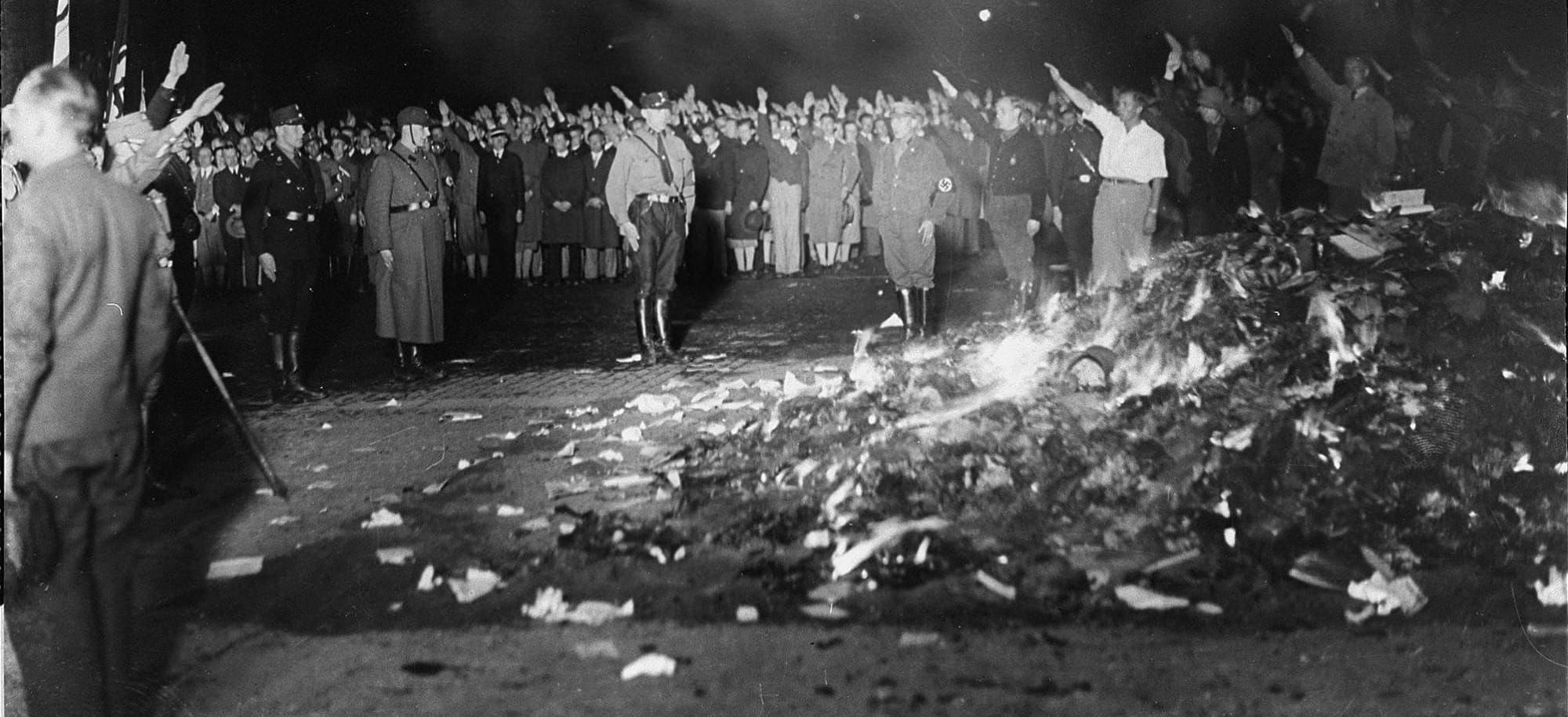
Before I read "The Intermediaries", I was only somewhat familiar with Hirschfeld, mostly because the Institute was a famous early target of book burnings by Nazis egged on by Josef Goebbels (see the picture above), a fact which in 2024 caused the grand wizard lady herself, JK Rowling, to spin into a rage when it was presented to her on Twitter.
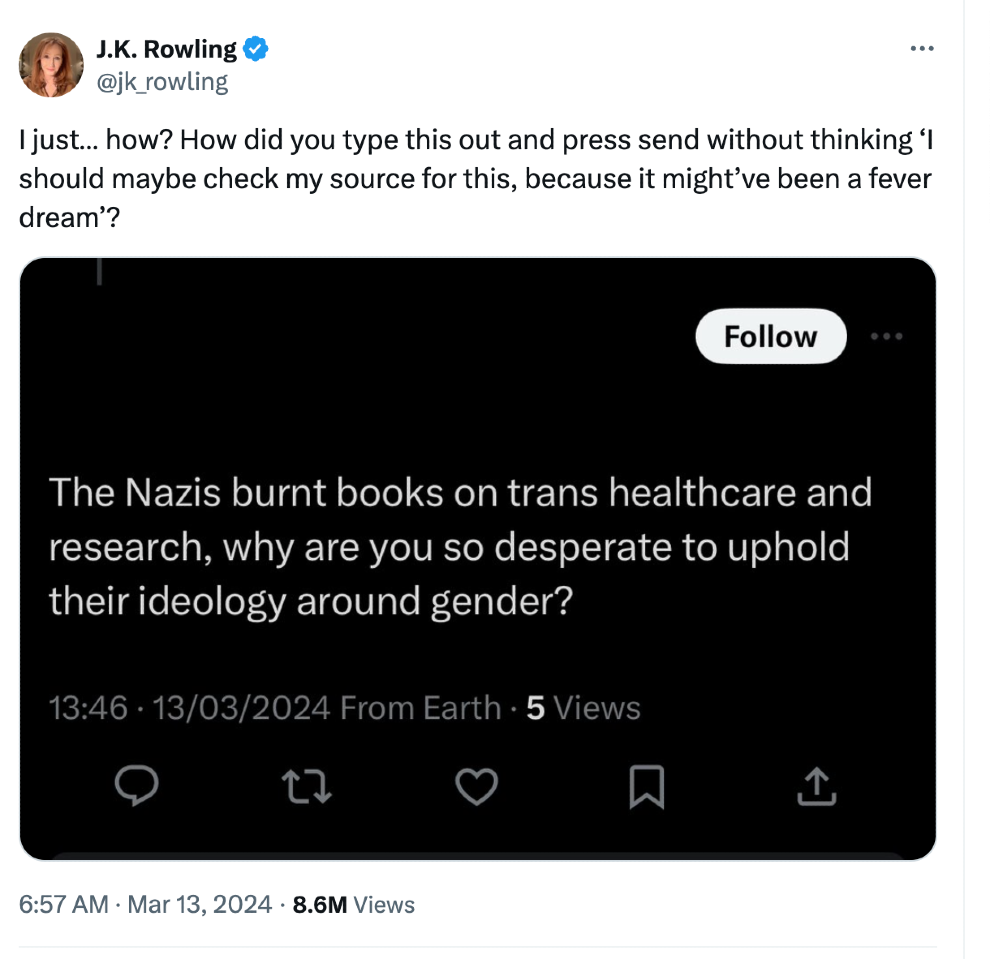
What I didn't know was how much influence Hirschfeld's work has had in the ensuing decades on our understanding of the needs of transgender people. Hirschfeld came to understand that sexuality, internal gender identity, and external gender presentation were all very separable phenomena and not necessarily connected to chromosomes and reproductive biology. In other words, the "gender ideology" that bigots insist is something new has been around for more than 100 years.
I also didn't know that Hirschfeld fought tirelessly against Paragraph 175, the German law that criminalized homosexuality. He helped produce a silent film in 1919 to raise awareness of its injustice. The movie, by the way, which can be found on Youtube, stars Conrad Veidt, better known as Major Strasser in Casablanca. It ended up being banned in much of Germany.
Writes Schillace: "Hirschfeld and his team would reassure the 'homosexual personality' by explaining that 'it has to do with an inborn orientation of the drive for which no one is to blame, which is not a misfortune in itself, but rather made so by the unjust prejudice' of others."
Sadly, as the Nazi Party rose to power, "the combined power of racism against Jews and the fear of losing masculine power cemented under German nationalism". Hirschfeld, being gay and Jewish, became “enemy number 1.”
I won't recap the entire book, but as I mentioned at the top, I think it is worth noting some of the parallels that stand out between Weimar Germany and the present-day United States.
"Germany's national identity," Schillace writes, "was not only masculine, it was pointedly anti-feminine." A common attitude presented in the book is a fear and revulsion by those in power of anything feminine contaminating the Spartan warrior ethos of the German culture. This parallels the ravings of our own Pete Hegseth who wants to rid our military of all but the manliest of (white) men.
Like in our current administration, gay people were tolerated in German governments, even under the Nazis, at least at first. Before World War I, a scandal involving a member of Kaiser Wilhelm's inner circle, a gay tryst, and state secrets triggered an anti-homosexual panic and "crisis of masculinity". Gay panic did in Ernst Rohm, Hitler's good friend and head of the SA (brownshirts), during the night of the long knives. Some homosexual men supported the Nazi movement because they thought themselves a "respectable" segment of the masculine culture. Some who were onetime allies of Hirschfeld turned against him to curry favor with the Nazis. They ended up dead or in the camps with the rest of the enemies of the State. Current Trump insiders Scott Bessent, Jacob Helberg, and Richard Grenell should beware.
It calls to mind this banger cartoon by Adam Ellis:
As an aside, while reading The Intermediaries, I was also reminded of the 1972 Norman Spinrad science fiction novel, "The Iron Dream", which presents as a pulp novel written by an alternate universe Adolph Hitler, who instead of going into politics came to the United States to be an illustrator and a writer. The subconscious homo-erotic imagery that Spinrad has issuing from alt-Hitler's pen is quite hilarious.
So, are we doomed to repeat history? I honestly don't know. I hope not. But I do know that the ones who need to learn from history are pointedly not doing so. And as Brandy Schillace writes "The books may not yet be burning, but they are already being banned. Then has become now."
The Intermediaries: A Weimar Story, by Brandy Schillace, is published by W.W. Norton and Company and is available via your independent bookstore, bookshop.org, or your friendly neighborhood public library.